


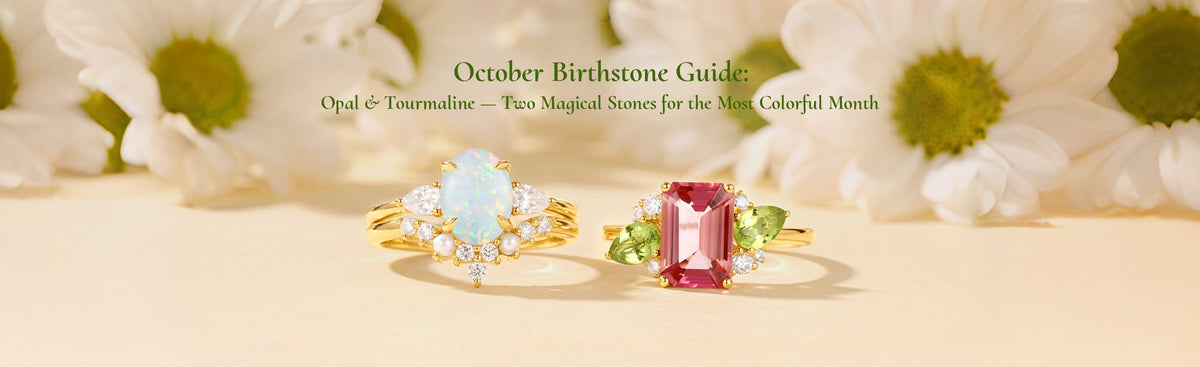
October is the only month of the year with two official birthstones, and it could hardly have picked a more magical pair. Opal shimmers with every color of the rainbow in a single stone, while tourmaline is nature's most color-versatile gem, appearing in everything from candy pink to forest green to electric blue. Together they make October the most colorful month on the birthstone calendar — and one of the most fun to shop for. If you have been browsing opal rings and wondering how the play-of-color actually works, or hunting for the perfect tourmaline ring, this guide will walk you through the history, the science, the honest natural-versus-lab comparison, and exactly how to choose a piece you will love for a lifetime.
At Felicegals, we set hand-selected opals and tourmalines into solid 14K and 18K gold and 950 platinum, so each piece is built to be worn every day. Whether you are shopping for an opal engagement ring, an october birthstone gift, or simply a colorful stone that speaks to you, this guide covers everything you need to choose with confidence — and you can browse the full range in our birthstone collection.
Table of Contents
- Why October Has Two Birthstones: Opal & Tourmaline
- Opal: The Rainbow Stone and the Science of Play-of-Color
- Tourmaline: The Most Colorful Gem on Earth
- Natural Opal vs Lab-Grown Opal: Price, Durability & Looks
- Opal vs Tourmaline Hardness & Everyday Care
- October Birthday Gift Ideas: How to Choose
- The Felicegals Opal & Tourmaline Collection
Why October Has Two Birthstones: Opal & Tourmaline
October's dual birthstone tradition is modern, but both stones carry centuries of symbolism. The birthstone list standardized in the early twentieth century gave most months a single stone, but a few were assigned alternates — and October's is the most famous. Opal is the traditional primary stone, while tourmaline was added as the official alternative in 1952, giving October-born people a choice between two very different personalities.
Opal has been treasured since antiquity. The ancient Romans believed it was the most precious of all gems because it contained the colors of every other stone combined, and they called it opalus. In the Middle Ages, opal was worn as a talisman of hope, purity, and good fortune, and an old Arab legend claims opals fell from the sky in flashes of lightning. Queen Victoria later made opal fashionable across Europe and helped rescue its reputation.
Tourmaline has a younger but equally rich story. The name comes from the Sinhalese word tura mali, meaning "stone of mixed colors." Dutch traders brought it from Sri Lanka to Europe in the 1700s, where it was used to warm and cool pipes because heating the stone created an electric charge — the first gem known to be pyroelectric. In the United States, a vivid pink tourmaline discovered in Maine in 1822 became a favorite of Tiffany & Co.
For October-born people, having two birthstones means the month's energy can be read two ways: opal represents creativity, hope, and emotional depth, while tourmaline represents balance, protection, and self-confidence. If you cannot decide between them, the good news is that both are stunning together — see how they pair in our October birthstone collection.
Opal: The Rainbow Stone and the Science of Play-of-Color
Opal is unlike any other gem on earth. It is not a crystal in the traditional sense — it is a hydrated form of silica (SiO₂·nH₂O) that contains anywhere from three to twenty-one percent water trapped inside its structure. Instead of forming a rigid crystal lattice, opal is made of tiny spheres of silica stacked in a regular three-dimensional pattern, and that microscopic structure is the secret behind its magic.
The phenomenon you see in a fine opal is called play-of-color — the dancing flashes of red, green, blue, and violet that shift as the stone is tilted. It happens because those millions of stacked silica spheres act like a diffraction grating: when light enters the stone, it bounces between the spheres and splits into its spectral colors, the same way a prism or a soap bubble breaks white light. The size of the spheres determines which colors appear — spheres around 200 nanometers produce red fire, while smaller spheres produce violet and blue.
The background, or "body tone," of an opal matters just as much as its flash. White opal has a pale, milky background with fire playing across it; black opal, the rarest and most valuable, has a dark background that makes the colors look electric and three-dimensional; and crystal opal is transparent and glassy, so its patterns appear to float inside clear water. Fire opal is a different story — an orange-to-red transparent stone that glows with a warm sunset body color.
Because opal displays best against a plain background, a clean metal setting lets the stone do the talking. Take a look at how that plays out in real pieces from our opal ring collection.


Tourmaline: The Most Colorful Gem on Earth
No gem shows up in more colors than tourmaline. It is a complex boron silicate mineral, and the wide variety of elements that can enter its crystal structure — iron, manganese, chromium, vanadium, lithium, copper — produces an extraordinary range of hues. Gemologists often call it the "rainbow gem" because it can appear in virtually every color of the spectrum.
The most beloved varieties each have their own character. Pink and red tourmaline (often called rubellite when the color is deep enough) glows with a warm, feminine energy. Green tourmaline (verdelite) ranges from mint to a deep forest green that rivals emerald with better clarity and durability. Blue tourmaline (indicolite) is the rarest of the mainstream colors. And then there is the showstopper: watermelon tourmaline, a single crystal with a pink core wrapped in a green rim, sliced to reveal both colors like a slice of fruit. Because tourmaline crystals are often strongly pleochroic — they show different colors from different angles — each stone has a depth a flat color cannot match.
Tourmaline also has a practical advantage: at 7 to 7.5 on the Mohs hardness scale, it is harder and tougher than opal, tanzanite, and emerald, which makes it a genuinely wearable everyday stone. That is why a tourmaline ring lets you wear a bold color without babying the jewelry — explore more in our birthstone collection.


Natural Opal vs Lab-Grown Opal: Price, Durability & Looks
If you have shopped for opal, you have probably noticed two very different price tags for stones that look almost the same. That is the difference between natural (mined) opal and lab-grown opal, and understanding it will help you decide which is right for the piece you have in mind. (Tourmaline is not commonly synthesized, so this comparison concentrates on opal.)
Natural opal is mined from the earth, most famously in Australia (which supplies the vast majority of the world's fine opal), along with Ethiopia, Mexico, and Brazil. Because it formed over millions of years with water and silica, natural opal carries genuinely random, one-of-a-kind patterns, and a top-grade black opal with vivid red fire can be worth more per carat than many diamonds. Natural opal also contains water, which means it can dry out, crack ("craze"), or lose its flash if exposed to heat or very dry conditions over time.
Lab-grown opal is created in a laboratory by recreating the conditions that form natural opal — the same microscopic silica spheres, the same hydration, the same optical structure. It is not a plastic imitation or a glass simulant; it is genuine opal synthesized in a controlled environment, which is why it is also called synthetic opal or lab-created opal. Because the growth is controlled, lab opal has remarkably uniform, vivid play-of-color, is far less likely to craze than natural opal, and costs a fraction of the price.
The trade-off is uniqueness: a lab opal's pattern is reproducible, while every natural opal is a one-of-a-kind accident of geology. Neither is "better" — it depends on what you value. If you want a large, brilliant, durable opal you can wear daily without worry, lab opal is the smarter buy. If you want a singular, mined treasure with authentic origin, natural opal is the one. Here is how the two compare side by side.
| Attribute | Lab-Grown / Synthetic Opal | Natural (Mined) Opal |
|---|---|---|
| Origin | Grown in a laboratory | Mined (Australia, Ethiopia, Mexico, Brazil) |
| Composition | Silica spheres + water (SiO₂·nH₂O) | Silica spheres + water (SiO₂·nH₂O) |
| Play-of-Color | Consistent, vivid, uniform | Random and unique; highly variable quality |
| Typical Price | Affordable — a fraction of natural | Wide range; fine black opal is extremely costly |
| Crazing Risk | Low — stable structure | Higher — water loss can cause cracking |
| Uniqueness | Repeatable, matched patterns | One of a kind — no two stones alike |
| Best For | Everyday wear, large stones, matched sets | Collectors, heirloom pieces, authentic origin |
At Felicegals, we are transparent about origin and offer both lab opal and natural opal designs, so you can choose the one that matches your priorities. Because lab opal lets us offer larger, more brilliant stones at a friendlier price, it is the foundation of many of our most-loved October birthstone pieces.


Opal vs Tourmaline Hardness & Everyday Care
Opal and tourmaline sit at opposite ends of the durability spectrum, and that difference should shape how you wear and care for each stone.
Opal rates only 5.5 to 6.5 on the Mohs hardness scale, which makes it one of the softer jewelry stones. It is also slightly porous and contains water, so it is vulnerable to scratching, knocks, and — most of all — drying out. The biggest enemies of opal are heat, sudden temperature changes, and very dry environments, all of which can cause the stone to craze. This does not mean opal is fragile jewelry, but an opal ring should be set with plenty of protective metal and worn with a little care.
Tourmaline rates 7 to 7.5 on the Mohs scale, noticeably harder and tougher than opal, and is suited to everyday wear in a way opal is not. The one thing to watch is tourmaline's cleavage — like many crystals, it has internal planes that can chip if struck sharply — so avoid hard knocks and remove it for contact sports.
| Care Factor | Opal | Tourmaline |
|---|---|---|
| Mohs Hardness | 5.5 – 6.5 | 7 – 7.5 |
| Everyday Wear | Ok with protective setting and care | Excellent — genuinely wearable daily |
| Best Setting | Bezel or halo to guard the edges | Prong, bezel, or halo — flexible |
| Cleaning | Lukewarm water + mild soap + soft cloth | Lukewarm water + mild soap + soft brush |
| Never Use | Ultrasonic, steam, heat, harsh chemicals | Ultrasonic on included stones; avoid steam |
| Storage | Separate pouch; keep from drying out | Separate pouch — away from harder gems |
| Remove Before | Gym, dishes, swimming, gardening | Contact sports, heavy lifting |
For both stones, the care rules are simple: clean gently with lukewarm water and mild soap, store separately from harder gems, and remove before swimming, cleaning, or the gym.
October Birthday Gift Ideas: How to Choose
October birthstone jewelry is one of the easiest gifts to get right, because both stones are naturally striking and suit almost any personal style. The trick is matching the stone, cut, and setting to the person you are buying for.
Match the stone to their personality. Opal suits someone creative, dreamy, or drawn to vintage and romantic styles — it is a stone that rewards a closer look. Tourmaline suits someone bold, modern, or color-forward, and it is the safer pick for a person who wears their ring every day and does not want to fuss over it.
Choose the color and shape. For opal, decide between a white opal's soft iridescence, a crystal opal's glassy translucence, or a warm fire opal's sunset glow. For tourmaline, pick a hue they actually wear — blush and rose pink, forest and mint green, or deep ocean blue. A ring is the classic birthstone gift, but a pendant or necklace lets the wearer keep the stone close to the heart without ring-size concerns.
Think about budget and add a personal touch. Lab opal lets you gift a larger, more brilliant stone for the same spend as a small natural one, while our natural opal pieces offer authentic mined origin at an accessible price. An engraving — a date, a name, or a short message — turns a beautiful ring into an heirloom. And if you cannot decide between the two stones, remember that October gives you both.
The Felicegals Opal & Tourmaline Collection
Every piece below is handmade to order in solid 14K or 18K gold or 950 platinum, with genuine opal or tourmaline center stones and colorless moissanite accents for extra sparkle. Because we offer both natural and lab-grown opal, you can shop by the priorities that matter to you — authenticity, size, or everyday durability. Here are our most-loved October birthstone designs.


Frequently Asked Questions
1. What are the October birthstones?
October has two official birthstones: opal (the traditional primary stone) and tourmaline (the modern alternative, added in 1952). Both are prized for their extraordinary color, and both make meaningful October birthday gifts.
2. Is opal or tourmaline better for an October birthstone ring?
It depends on how you plan to wear it. Tourmaline is harder (7–7.5 on the Mohs scale) and better suited to daily wear, while opal is softer (5.5–6.5) and needs a protective setting and a little care. For an everyday ring, tourmaline is more forgiving; for a romantic, display-worthy stone, opal is hard to beat.
3. What causes the play-of-color in opal?
Play-of-color comes from opal's internal structure — millions of tiny silica spheres stacked in a regular pattern. When light enters and diffracts between the spheres, it splits into spectral colors, producing the shifting flashes of red, green, blue, and violet that make opal unique.
4. Is lab-grown opal a real opal?
Yes. Lab-grown (synthetic) opal has the same silica-and-water composition and the same optical structure as natural opal — it is genuine opal created in a laboratory rather than a glass or plastic imitation, with more consistent play-of-color and greater resistance to crazing.
5. How much does an opal engagement ring cost at Felicegals?
Our opal rings generally range from about $899 for a lab opal signature design to around $4,199 for a large two-piece set with a kite-cut center stone. Lab opal pieces are the most affordable, while natural opal and multi-stone sets sit at the higher end.
6. How should I care for an opal ring?
Clean opal gently with lukewarm water and a drop of mild soap, then pat dry with a soft cloth. Avoid ultrasonic and steam cleaners, heat, and harsh chemicals, and remove the ring before swimming, cleaning, or the gym. Store it away from very dry heat to prevent crazing.
7. What colors does tourmaline come in?
Tourmaline appears in nearly every color: pink and red (rubellite), green (verdelite), blue (indicolite), yellow, orange, brown, colorless, and the famous watermelon tourmaline with a pink core and green rim. It is often called the rainbow gem for exactly this reason.
8. Where can I find October birthstone jewelry, and can I ask a question first?
You can browse the full range of October birthstone jewelry at Felicegals, where every piece is handmade to order in solid gold or platinum. If you are unsure whether opal or tourmaline suits your recipient, we are happy to guide you personally — just email us at support@felicegals.com.
