


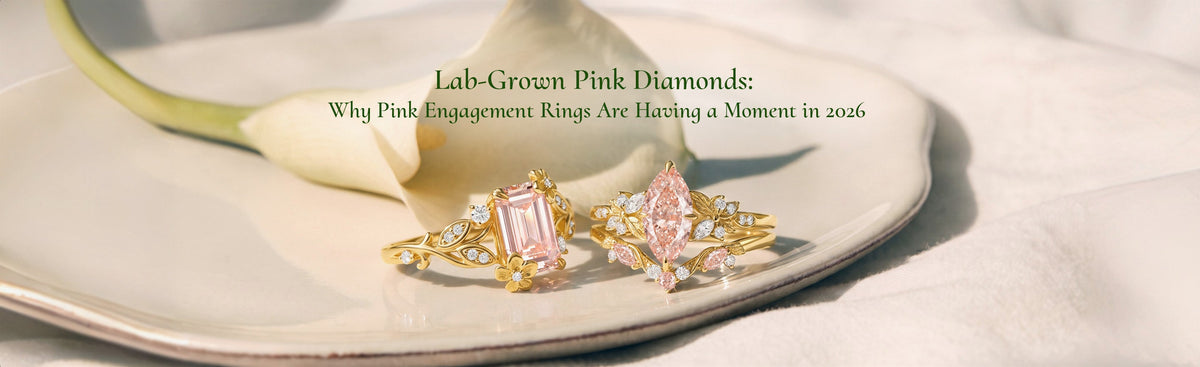
If a lab grown pink diamond has suddenly appeared on every engagement inspiration board you follow, you are watching one of the defining jewelry shifts of the decade unfold in real time. A pink engagement ring used to mean a once-in-a-generation auction stone or a distant heirloom — beautiful, rare, and almost impossibly out of reach. That has changed. A pink diamond engagement ring can now be designed in the exact blush or magenta you dream about, at a fraction of the natural price, with verifiable certification and a lead time measured in weeks rather than years. A colored diamond ring in a warm, romantic pink is genuinely available to you today.
At Felicegals, pink is not a seasonal novelty — it is a signature. Every piece in our colored-diamond line is lab-grown, so color, clarity, and cut are consistent and verifiable rather than left to the unpredictable natural market. That control makes a pink lab diamond in 2026 such an intelligent choice: you fall in love with a shade because it is beautiful, not because it happens to be the only one available. This guide covers why pink is having its moment, how lab-grown pinks get their color, how they compare with natural stones, and how to choose a ring you will still adore in thirty years.
Table of Contents
- Why Pink Diamonds Are Everywhere in 2026
- How Lab-Grown Pink Diamonds Get Their Color
- Lab-Grown vs Natural Pink Diamonds: What Actually Differs
- Pink Diamond Shades: Blush, Rose, Magenta & Everything Between
- The Trending Pink Silhouettes: Marquise, Kite, Pear & Oval
- How to Choose a Pink Ring You Will Love for Decades
- The Felicegals Colored-Diamond & Pink Collection
Why Pink Diamonds Are Everywhere in 2026
Pink has been building momentum for years, but 2026 is the year it moved from niche to mainstream. Three forces are converging at once. First, the traditional supply of natural pink diamonds has effectively collapsed: the Argyle mine in Western Australia, which produced roughly 90% of the world's natural pinks, closed in 2020, and the stones that once flowed from it have become true collector's items. Second, lab-grown technology has matured to the point where pink is no longer a compromise shade — it can be produced with rich, stable, deeply saturated color that rivals anything the earth ever made. Third, a generation of buyers who came of age on Instagram and Pinterest simply does not want the same ring their parents had, and pink is the clearest possible statement of "this is mine."
The cultural shift matters as much as the commercial one. Brides are increasingly drawn to color as self-expression, and pink hits a rare sweet spot: romantic and feminine without being saccharine, modern without being cold. It flatters nearly every skin tone, photographs beautifully, and reads as personal rather than prescribed. Combine that emotional pull with genuine technical capability and a supply vacuum at the top of the natural market, and you get exactly what we are seeing — a category that is no longer emerging, but arriving. Add the practical math — a natural fancy pink starts in the tens of thousands, while a lab-grown pink of comparable beauty can be measured in the thousands — and the case becomes irresistible.
How Lab-Grown Pink Diamonds Get Their Color
To understand why lab-grown pink diamonds look the way they do, it helps to know how they are made. Lab-grown diamonds are real diamonds — they share the same chemical composition (pure crystallized carbon), crystal structure, refractive index, and 10 on the Mohs hardness scale as mined diamonds. The only difference is origin: they are grown from a tiny carbon seed rather than formed over billions of years underground, typically using the HPHT (High-Pressure High-Temperature) or CVD (Chemical Vapor Deposition) method.
Pink, however, is special. In nature, a pink diamond's color does not come from a chemical impurity the way a blue diamond's boron or a yellow diamond's nitrogen does. Pink is the result of structural distortion — a subtle deformation in the crystal lattice that alters how light passes through the stone, producing that unmistakable rosy glow. Reproducing this in a lab means engineering the growth environment with extraordinary precision so the crystal forms with the exact lattice characteristics that create pink.
Here is what that means for you as a buyer:
- Color is engineered, not accidental. Lab-grown pinks can be tuned to a target shade — from the palest whisper of blush to a deep, vivid magenta — with consistency across every stone.
- Stability. Because the color is intrinsic to the crystal itself, it will not fade, change, or require re-treatment over time. The pink you buy is the pink you keep.
- No color zoning. Natural pinks frequently show uneven patches of stronger and weaker color; lab-grown stones can be grown to display a single, even, face-up shade.
- Verifiable certification. At Felicegals, every lab pink diamond comes with an IGI certificate documenting its identity as a lab-grown stone.
Lab-Grown vs Natural Pink Diamonds: What Actually Differs
The single most common question we hear is some version of "are they really the same?" The honest answer is nuanced, best understood through the variables that actually matter when choosing a ring. Visually, optically, and chemically, a lab-grown pink and a natural pink of the same grade are indistinguishable to the unaided eye. The differences lie in price, availability, the natural range of color, and the story behind the stone.
| Factor | Lab-Grown Pink Diamond | Natural Pink Diamond |
|---|---|---|
| Price | Typically 70–90% less than a comparable natural pink; a 1ct fancy pink can be found in the low thousands | Extremely high; 1ct fancy pinks commonly start around $50,000 and can exceed $1,000,000 for top stones |
| Availability | Reliable and repeatable; can be ordered in the exact size and shade required | Scarce and unpredictable; supply sharply reduced since the Argyle mine closed in 2020 |
| Color Intensity | Engineered to a consistent target shade with even face-up color and no zoning | Wide natural variation; most pinks are faint to light, with vivid fancy colors extremely rare |
| Ethics & Sourcing | Conflict-free by definition, no mining footprint, fully traceable chain of custody | Ethically mined stones exist but require careful provenance verification; mining carries environmental impact |
| Size Range | Available from small accents to large center stones without exponential price jumps | Priced exponentially by size; larger fancy pinks are auction-tier and effectively unattainable |
| Durability | 10 on the Mohs scale — identical to natural diamond | 10 on the Mohs scale |
| Certification | IGI certificate identifying the stone as lab-grown | GIA or similar report noting natural origin (and often treating color as the primary value driver) |
What the table makes clear is that the genuine differences are practical, not optical. If what you love is the look of pink — the glow, the sparkle, the way it flatters the hand — a lab-grown stone delivers that experience without the price ceiling or the scarcity. If what you love specifically is the provenance of a rare mined gem, that is a different and legitimate desire. But for the vast majority buying a pink ring to wear and enjoy, lab-grown is simply the more rational and more romantic choice.
Pink Diamond Shades: Blush, Rose, Magenta & Everything Between
Pink is not one color — it is a spectrum, and the shade you choose shapes the entire personality of your ring. Gemologists describe pink diamonds by saturation and tone, from barely-there tint to intense magenta.
At the softest end is blush pink, a delicate, almost-translucent tint that reads as the palest suggestion of rose. Blush is subtle and ethereal; it pairs beautifully with thin bands and clean solitaires. Slightly deeper is rose — a warmer, richer pink with more presence, the shade most people picture when they imagine a romantic colored diamond. Rose flatters warm skin tones especially and looks luminous in yellow or rose gold.
Moving up the scale, hot pink and magenta are the statement shades — bold, saturated, and attention-grabbing, for the buyer who wants the color itself to be the headline. Between these poles sits a vast range of intermediate shades, and the beauty of lab-grown pinks is that you can dial in precisely which one feels like yours.
A few practical notes on choosing your shade:
- Metal matters. Rose and yellow gold warm up a pink stone; white gold and platinum create a cooler, more contrast-driven look.
- Skin tone matters. Warmer complexions tend to glow with rose and blush pinks; cooler complexions can carry magenta and lilac-leaning pinks beautifully.
- Occasion matters. A blush solitaire reads as timeless and bridal; a vivid magenta cluster reads as bold and modern.
The Trending Pink Silhouettes: Marquise, Kite, Pear & Oval
Pink diamonds reward dramatic cuts. Because the color is the star, elongated and unusual silhouettes that maximize face-up size and capture light across a long axis showcase pink more beautifully than a standard round brilliant. Four shapes lead the trend in 2026.
The marquise is the classic romance cut — an elongated, eye-shaped stone that stretches the finger and catches light in a slow, liquid shimmer. The kite cut is the modern darling: a sharply faceted, four-sided silhouette that looks architectural and contemporary, its angular planes scattering pink light in unexpected flashes. The pear (or teardrop) blends a round brilliant's sparkle with a marquise's elongation, tapering to a point — soft, organic, and endlessly romantic. The oval is universally flattering, maximizes perceived size, and gives pink a bright, even, generous face-up display.
Choosing between them comes down to the feeling you want the ring to convey. Marquise and pear read as romantic and vintage-inspired; kite reads as bold and avant-garde; oval reads as timeless and classic. Many of our pink designs layer these shapes into matching two-piece sets, so the center stone's silhouette is echoed in the band for a cohesive, intentional look.
How to Choose a Pink Ring You Will Love for Decades
A pink ring is a long-term commitment to a color, so it is worth choosing deliberately. A few clear principles will carry you through the decision with confidence, whether you are buying a bold statement piece or a delicate everyday ring.
Start with the shade, not the setting. The color is what you will notice every day for the rest of your life, so decide on your pink first — blush, rose, or magenta — and let the setting follow. It is easier to find a mounting that suits a chosen shade than the reverse.
Choose metal that serves the stone. Warm metals (yellow and rose gold) enhance rose and blush pinks, while cool metals (white gold and platinum) create crisp contrast that makes cooler, more saturated pinks pop. Our designs come in 14K and 18K gold in multiple colors as well as 950 platinum.
Prioritize comfort, certification, and craftsmanship. A ring you wear for decades must feel effortless — a comfortable band width (most of our settings use a slim 1.5–1.6mm band), a secure setting, and a design that will not date. Insist on certification: every Felicegals lab diamond arrives with an IGI certificate and is covered by our warranty even though, as a made-to-order piece, it is not eligible for exchange or return.
Finally, think about how the ring will live with you. If you want a single timeless piece, a blush solitaire or oval is nearly impossible to regret. If you love a set you can wear together or separately, a two-piece design gives you versatility and value. Buy the pink that feels unmistakably like you, and you will never tire of it.
The Felicegals Colored-Diamond & Pink Collection
Every ring in our pink collection features lab-grown stones with verifiable certification, grown to deliver rich, stable color across a full range of shades — from delicate blush to vivid magenta. We have grouped our designs into three families: pure pink lab diamonds, pink lab sapphire accents, and cluster and statement pinks — shown across the trending silhouettes of marquise, kite, pear, and oval.


Peony — Marquise Lab Pink Diamond Cluster Set 2pcs
Price: $4,299 – $5,299
The Peony pairs a 1.0ct pink lab diamond with pink and white lab diamond accents on a slim 14K solid gold band. The marquise cut stretches across the finger, while the cluster setting amplifies the pink for a luminous, layered glow. A two-piece set that reads as effortless luxury. Ships with an IGI certificate.
Arbor — Marquise Lab Pink Diamond Cluster Ring
Price: $2,999 – $5,899
The Arbor centers a 1.0ct pink lab diamond in a marquise cut, framed by lab diamond accents on a 1.5mm band. Where the Peony is a set, the Arbor is a singular solitaire-style statement — cleaner, more architectural, and endlessly versatile. Made to order with an IGI certificate.
Magnolia — Pear Shaped Pink Lab Grown Diamond Leafy Ring
Price: $1,999 – $2,999
The Magnolia is where pink meets nature-inspired design. A pear-shaped pink lab diamond of about 0.5ct sits at the heart of a leafy gold ring, with 0.4ct of lab diamond accents tracing the vine-work of the band. The pear cut tapers softly and catches light like a dewdrop. A gentle, garden-romance piece.
Phyllon — Leafy Kite Pink Lab Grown Diamond Ring Set 2pcs
Price: $4,399 – $5,399
The Phyllon is a modern classic. A 1.0ct pink lab grown diamond in a sharp kite cut anchors a leafy two-piece set, with lab diamond accents along a 1.5mm band. The kite silhouette gives the pink a bold, contemporary edge that scatters light in crisp flashes, while the foliage detailing keeps the impression warm.
Lydia — Kite Cut Pink Lab Grown Diamond Butterfly Set 2pcs
Price: $3,999 – $4,999
The Lydia (our Fairy Ring) pairs a 1.0ct kite cut pink lab diamond with butterfly-inspired detailing and 0.2ct of lab diamond side accents on a 1.6mm band. Whimsical and unexpected, the kite cut's geometry softened by fairy-wing motifs, the pink glowing at the center like a captured sunset.
Our next family shifts the pink from diamond to lab pink sapphire — a stone that offers a softer, slightly more diffuse blush at a friendlier price, while keeping the same handcrafted, nature-inspired spirit.


Peony — Marquise Lab Pink Sapphire Leafy Set 2pcs
Price: $1,699 – $2,699
The Peony sapphire set features a luminous blush-pink marquise lab sapphire of 5×10mm in a four-prong setting, with two bands carved into vine-and-leaf patterns and dotted with tiny marquise pink sapphires and white moissanites. A best-seller for its tender symbolism and garden-grown elegance.
Ines — Lab Pink Sapphire Marquise Leafy Set 2pcs
Price: $1,699 – $2,699
The Ines centers a 5×10mm marquise lab pink sapphire on a solid yellow gold band, accented with colorless moissanite, additional lab pink sapphire, and lab alexandrite for a subtle, shifting depth. The moissanite accents are VS to VVS clarity, and the set is 100% handmade for you.
Posey — Marquise Firework Lab Pink Sapphire Flower Set 2pcs
Price: $1,899 – $2,899
The Posey takes a 5×10mm marquise lab pink sapphire and surrounds it with a "firework" cut and floral detailing, accented by colorless moissanite and lab pink sapphire at VS to VVS clarity. The fireworks cut multiplies the stone's facets into bursts of light for a lively, celebratory shimmer.
Finally, our cluster and statement pinks collect the boldest, most sculptural designs — the pieces that turn a pink stone into a genuine focal point. These are the rings you notice from across a room.


Frequently Asked Questions
1. Are lab-grown pink diamonds real diamonds?
Yes. Lab-grown diamonds are chemically, physically, and optically identical to mined diamonds — same carbon composition, crystal structure, and 10 on the Mohs hardness scale. Each comes with an IGI certificate identifying it as lab-grown. The pink color is engineered during growth and is stable and permanent.
2. How much does a pink engagement ring cost?
A lab-grown pink diamond engagement ring typically ranges from a few thousand dollars up to the mid five figures depending on size, cut, and setting. At Felicegals, pink designs range from $1,699 to $5,899. A comparable natural fancy pink can cost ten to a hundred times more — a main reason lab-grown pinks have become so popular.
3. Will the pink color fade or change over time?
No. The color of a lab-grown pink diamond is intrinsic to the crystal lattice, not a surface treatment or coating, so it will not fade, shift, or require re-treatment. The pink you buy today is the pink it will be decades from now.
4. What is the difference between a pink lab diamond and a pink lab sapphire?
A pink lab diamond is a diamond — the hardest gemstone, with maximum sparkle and white-diamond brilliance. A pink lab sapphire offers a softer, more diffuse blush at a more accessible price. The choice comes down to diamond-level brilliance versus a gentler pastel look.
5. Which pink diamond shade is most popular in 2026?
Blush and rose pinks are the most requested shades, valued for their romantic, flattering warmth and versatility. Vivid magenta and hot pink are the fastest-growing statement choices, especially for cluster and kite-cut designs.
6. What cuts look best with a pink stone?
Elongated and specialty cuts showcase pink especially well. Marquise and pear pinks read as romantic and vintage-inspired, oval pinks are timeless and flattering, and kite-cut pinks bring a bold, modern feel. All four maximize face-up color and light return.
7. Do Felicegals pink rings come with certification?
Yes. Every lab pink diamond ring and set comes with an IGI certificate documenting its identity and quality. Because our pieces are made to order, please allow a 5–8 week lead time for diamond designs. Lab diamond pieces are covered by our warranty.
8. How do I choose the right pink ring for me?
Start with the shade you love, then match the metal (warm golds for rose and blush, cool metals for saturated pinks) and the silhouette (marquise, kite, pear, or oval) to your style. View the stone under multiple light sources. Explore the full Felicegals pink collection at colored diamond rings, and for questions about a specific stone or shade, reach us at support@felicegals.com.
