


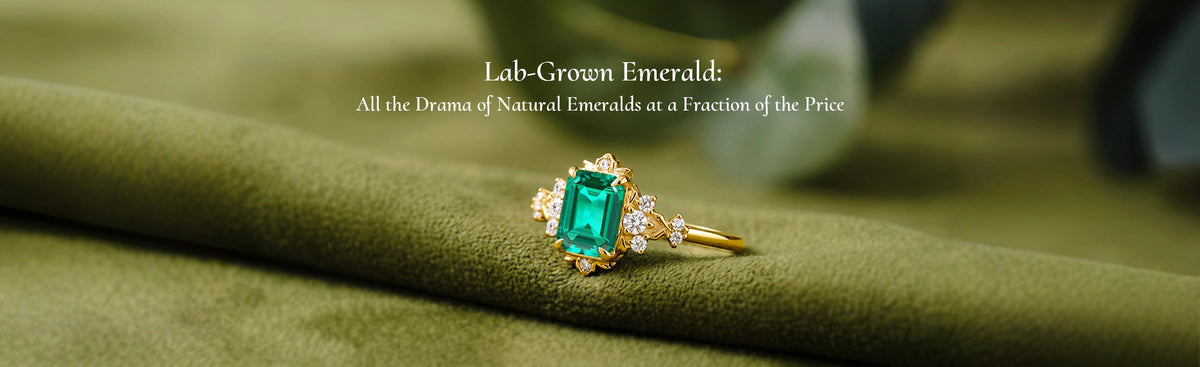
If you have been searching for a lab grown emerald ring, you already know the feeling: that deep, velvety green that has captivated royalty, poets, and brides for more than four thousand years — but attached to a price tag that can feel like a ransom note. A natural emerald of genuine quality is one of the rarest gems on earth, and its rarity is reflected in every carat. The good news is that modern gem science has changed the equation completely. Today, a lab created emerald ring delivers the exact same lush green drama as a mined stone, with none of the fragility, the inclusions, or the five-figure premium that natural emeralds demand.
At Felicegals, every emerald we set is grown in a laboratory that replicates the natural conditions of beryl crystallization — the same heat, pressure, and trace elements of chromium and vanadium that give an emerald its signature color. The result is a stone with identical chemistry and identical optical beauty, minus the ethical and financial baggage of mining. Whether you are designing a synthetic emerald engagement ring or simply drawn to a green gemstone ring 2026 style, this guide covers the history, the science, the honest comparison, and the settings that let an emerald shine without putting it at risk.
Table of Contents
- Why Emeralds Have Always Been Royal
- The Problem with Natural Emeralds: Price, Jardin & Fragility
- Lab-Grown Emeralds: Same Chemistry, Cleaner Color, Friendlier Price
- Lab-Grown vs Natural Emerald: How to Tell Them Apart
- Green Is the Color of 2026
- Setting & Care Advice for Emerald Rings
- The Felicegals Lab Emerald Collection
Why Emeralds Have Always Been Royal
Emerald is one of the four "precious" gemstones — the elite club that also includes diamond, ruby, and sapphire. Among these, emerald is the only green stone, and that singular status has made it the object of obsession for every major civilization that encountered it. The name itself comes from the Greek smaragdos, meaning "green gem," and the stone has been mined and treasured since at least 1500 BCE.
No figure is more associated with emerald than Cleopatra. The last active ruler of Ptolemaic Egypt was legendary for her devotion to the green stone — she claimed ownership of all emeralds in the empire and gave them as diplomatic gifts to visiting dignitaries. Her emerald mines, rediscovered centuries later as the Cleopatra Mines, are among the oldest known sources of the gem. For Cleopatra, emerald was not merely jewelry; it was a statement of power, fertility, and divine right.
The stone's mystique traveled well. In ancient Rome, the emperor Nero reportedly watched gladiatorial combat through a polished emerald lens — partly to soothe his eyes, partly because owning such a large emerald was itself an act of dominance. In India, the Mughals carved sacred texts into emerald surfaces, treating the stone as a talisman of wisdom and eternal life.
That historical weight is why emerald still reads as "royal" today. When you put on an emerald ring, you are wearing the same symbol that marked Cleopatra as a queen. And here is the modern twist: the color that once required a kingdom's treasury to own is now available at Felicegals for a fraction of what a comparable natural stone would cost, without sacrificing that regal green.
The Problem with Natural Emeralds: Price, Jardin & Fragility
For all their beauty, natural emeralds come with three stubborn problems that every buyer eventually confronts: price, inclusions, and fragility. Understanding these is the key to appreciating why lab-grown emeralds are not a "compromise" but a genuine upgrade.
Price. Natural emerald is genuinely rare. A fine, untreated, one-carat natural emerald of good color can easily run $3,000 to $10,000 per carat, and exceptional stones from Colombia's Muzo or Chivor mines can exceed $50,000 per carat at auction. The reason is geological: emerald forms only under a narrow, unusual set of conditions, and the same tectonic violence that creates it also tends to crack it. Only a tiny fraction of mined emerald rough is clean enough to become a fine gemstone. You are paying, in large part, for the scarcity of the surviving stones — not for anything you can actually see.
Jardin. Almost every natural emerald contains visible internal inclusions — fractures, tiny crystals, and fluid-filled cavities. Gemologists call this internal garden jardin (French for "garden") because the inclusions can look like moss or foliage suspended inside the stone. While some collectors romanticize jardin as proof of natural origin, the practical reality is that heavy jardin reduces brilliance and transparency. A natural emerald is often more "included" than a comparable ruby or sapphire by an order of magnitude.
Fragility. Emerald is a beryl, and beryl ranks 7.5 on the Mohs hardness scale. That sounds respectable, but hardness is only part of the story. Emerald's problem is not hardness but toughness: because natural stones are riddled with internal fractures, they are prone to chipping and cracking along those planes when struck. This is why emeralds are almost always "oiled" — a treatment that fills surface-reaching fractures with a colorless oil or resin to improve clarity and stability. Even so, a natural emerald ring requires careful, protective setting and mindful everyday wear.
None of this makes natural emeralds bad — they are magnificent, historically significant objects. But it does mean that a buyer who wants a durable, eye-clean, vivid green stone for a ring worn every day is often better served by the laboratory than by the mine.
Lab-Grown Emeralds: Same Chemistry, Cleaner Color, Friendlier Price
Lab-grown emerald is not imitation emerald — this is the most important thing to understand. Imitations such as glass or green cubic zirconia merely look like emerald; a lab-grown emerald is emerald. It has the same chemical formula (Be₃Al₂Si₆O₁₈), the same crystal structure, the same refractive index (1.577–1.583), and the same specific gravity as a mined stone. The only difference is where it grew.
There are two main methods used to grow emerald in a laboratory. The flux-growth method dissolves the raw ingredients in a molten flux and slowly cools them, allowing emerald crystals to form over weeks or months — this method tends to produce emeralds with natural-looking internal characteristics. The hydrothermal method replicates the hot, mineral-rich water solutions in which emeralds form in the earth, producing crystals of exceptional clarity and color uniformity. Both methods yield genuine emerald that passes the same chemical tests as a mined one.
Here is what that means in practice for a ring you will actually wear:
- Cleaner color and clarity. Because growth is controlled, lab emeralds are typically "eye-clean" — vivid, saturated green with far less dramatic jardin than natural stones. You get the color you fell in love with, without the cloudiness.
- Remarkable consistency. Every lab emerald in a matched set is color-matched. Natural emeralds vary wildly from stone to stone, which makes pairing them a nightmare; lab stones are grown to spec.
- Ethical and environmental peace of mind. No mining, no displaced communities, no conflict-adjacent supply chains, and a fraction of the carbon and water footprint.
- Friendlier price — dramatically so. A lab-grown emerald of the same size and color as a natural one can cost 80–90% less. That savings is what lets you choose a larger center stone, a richer setting, or a full two-piece ring set for the price of a modest natural solitaire.
In other words, lab-grown emerald lets you have the drama of a natural emerald — the deep, unmistakable royal green — while keeping your budget, your conscience, and your wearability intact. Explore the full range of lab emerald engagement rings to see how far that value stretches.
Lab-Grown vs Natural Emerald: How to Tell Them Apart
Can you tell a lab-grown emerald from a natural one with the naked eye? Almost never — and that is exactly the point. The two stones are chemically identical, so the difference is invisible without specialized equipment. What separates them in the marketplace is documentation, origin, and price. Here is a side-by-side breakdown of the qualities that actually matter.
| Attribute | Lab-Grown Emerald | Natural Emerald |
|---|---|---|
| Chemical Composition | Be₃Al₂Si₆O₁₈ (beryl) | Be₃Al₂Si₆O₁₈ (beryl) |
| Hardness (Mohs) | 7.5 | 7.5 |
| Refractive Index | 1.577 – 1.583 | 1.577 – 1.583 |
| Typical Clarity | Eye-clean, minimal inclusions | Visibly included (jardin) |
| Color Consistency | Excellent — grown to spec | Highly variable |
| Typical Price (1 ct) | $100 – $500 | $3,000 – $10,000+ |
| Treatments | None needed | Commonly oiled or resin-filled |
| Origin | Laboratory | Mined (Colombia, Zambia, Brazil, etc.) |
| Ethical Footprint | Minimal | Significant (mining impact) |
The practical takeaway: if two emeralds of the same size and color sat side by side on a jeweler's tray, you would almost certainly be unable to tell which was grown and which was mined. Even trained gemologists rely on microscopic examination — checking for characteristic growth patterns and inclusion types — to make the call, and often require advanced spectroscopy to be certain.
This is why, at Felicegals, we are fully transparent about origin. Every emerald we sell is disclosed as lab-grown, and the value proposition is simple: you are paying for the beauty of the stone and the craftsmanship of the setting, not for a scarcity premium you cannot see or verify. For a ring you will wear and love every day, that is a far better deal than chasing the "natural" label at five to twenty times the price.
Green Is the Color of 2026
Color trends move in cycles, and green has been building momentum for several seasons — but 2026 is shaping up to be the year green fully takes over bridal. After years of neutral minimalism — white diamonds, beige palettes, quiet luxury — designers and shoppers alike are craving color that feels alive, optimistic, and personal. Green delivers all three.
There is also a deeper symbolism at play. Green is the color of growth, renewal, and vitality — values that resonate powerfully in a year when couples are thinking about sustainability, longevity, and building a life with intention. An emerald engagement ring says something a diamond cannot: it signals that your love is evergreen, rooted, and growing. That sentiment is exactly why the green gemstone ring 2026 aesthetic has moved from niche to mainstream.
On the runway and in bridal editorials, the green trend shows up in a few distinct ways. Emerald-cut stones — a rectangular step cut with cropped corners — are having a major moment, their clean geometry matching the architectural mood of current fashion. Toi et moi settings are being reimagined with a green emerald beside a white moissanite for a fresh two-tone look. And nature-inspired designs — leafy vines, beaded edges, organic asymmetry — are flourishing, because emerald's botanical green pairs naturally with garden motifs.
What makes 2026 different from previous green revivals is accessibility. Because lab-grown emeralds have slashed the cost of vivid green by an order of magnitude, this trend is not reserved for collectors with auction-house budgets. A bride choosing a lab-grown emerald ring today is participating in the same aesthetic conversation as the red-carpet set — but at a price that leaves room for the wedding itself.
Setting & Care Advice for Emerald Rings
Because emerald measures 7.5 on the Mohs scale — below diamond (10), sapphire and ruby (9), and even quartz (7, though quartz is tougher) — it needs a setting that protects it. The good news is that a well-designed setting can make an emerald perfectly wearable for everyday life. Here is how to think about it.
Choose a protective setting. A bezel setting, which wraps a rim of metal around the stone's outer edge, is the most protective option and works beautifully with modern emerald-cut stones. A halo — a ring of small accent stones around the center — offers good protection too, cushioning the emerald's girdle from bumps. If you love the open, light-loving look of a prong setting, ask for a low profile and sturdy prongs that sit above the stone's corners.
Avoid high-risk activities. Emerald is vulnerable to hard knocks and thermal shock. Remove your emerald ring before the gym, gardening, or dishwashing, and keep it out of hot water and steam — sudden temperature changes can stress treated or included stones.
Clean gently. The safe method is simple: lukewarm water, a drop of mild dish soap, and a soft-bristled baby toothbrush. Brush gently around the setting, rinse, and pat dry. Never use ultrasonic or steam cleaners on emerald — the vibrations and heat can damage the stone or strip any treatment.
Store separately. Because emerald is softer than diamond, sapphire, and moissanite, it can be scratched by them. Store your emerald ring in its own soft pouch or a compartment separated from harder gems — one habit that keeps your stone crisp for decades.
| Care Factor | Recommendation |
|---|---|
| Hardness | 7.5 Mohs — protect from hard knocks |
| Best Setting | Bezel or halo for daily wear |
| Cleaning | Lukewarm water + mild soap + soft brush |
| Never Use | Ultrasonic or steam cleaners |
| Storage | Separate pouch — away from harder gems |
| Remove Before | Gym, gardening, dishes, swimming |
Treat your emerald with the same consideration you would give any fine gemstone, and it will reward you with a lifetime of vivid green brilliance. For a deeper dive into gemstone maintenance, see our care guide in the Related Reading section below.
The Felicegals Lab Emerald Collection
Every ring below features a genuine lab-grown emerald, set in solid 14K or 18K gold or 950 platinum, with the option of colorless moissanite accents for extra sparkle. Each piece is handmade to order. Here are eight of our most-loved designs — spanning geometric, nature-inspired, vintage, and modern styles — so you can find the green that matches your story.


Beryl — Long Hexagon Lab Emerald Ring Set 2pcs
Price: $1,799 – $2,799
The Beryl pairs an elongated hexagon lab emerald with an infinity-symbol wedding band, framed by retro beaded edges for a vintage-modern silhouette. The geometric center stone is bold and architectural, while the emerald's deep green keeps the look grounded and luxurious. Available in 14K and 18K gold and 950 platinum.
Mossy — Nature Inspired Oval Cut Lab Emerald Leafy Set 2pcs
Price: $1,699 – $2,699
The Mossy is a nature lover's dream: an oval-cut lab emerald (6×8mm, about 1.5ct) cradled in a leafy, vine-inspired two-piece set. The oval shape is universally flattering on the hand, and the organic detailing gives the ring a garden-wedding romance. A stone-selection service is available if you would like to choose your exact emerald.
Emerald Cut Lab Emerald & Moissanite Yellow Gold Ring
Price: $1,199 – $1,699
A classic emerald-cut lab emerald (6×8mm) set in a solid 14K yellow gold band with colorless moissanite accents in a halo. The step-cut geometry shows off the emerald's clean, vivid green with maximum sophistication, while the moissanite halo adds brilliant sparkle. Comfortable, timeless, and an exceptional value.
Dyad — Toi Et Moi Lab Emerald & Moissanite Ring
Price: $1,899 – $2,999
The Dyad is a modern toi et moi design, pairing a pear-cut lab emerald with a moissanite center stone on a single band, finished with baguette accent stones. Two stones, two stories, one ring — a romantic symbol of two lives joined. A striking choice for anyone who wants the green trend with a contemporary twist.
Zinnia — Marquise Cut Leafy Lab Emerald Set 2pcs
Price: $1,899 – $2,799
The Zinnia features a marquise-cut lab emerald (5×10mm) in a leafy two-piece set with colorless moissanite accents. The marquise shape elongates the finger beautifully, and the botanical setting channels the organic, garden-inspired mood that defines the 2026 green trend. A distinctive, romantic silhouette.
Pear Shaped Lab Emerald Rose Gold Ring Set 2pcs
Price: $1,429 – $1,909
The Pear Shaped set pairs a pear-cut lab-created emerald (6×8mm) with a bezel-set, beaded art-deco chevron wedding band. The bezel setting adds protection for everyday wear, while the V-shaped band and rose gold option give the ring a soft, romantic warmth that flatters the green center stone.
Lark — Kite Cut Lab Emerald Leafy Set 2pcs
Price: $1,699 – $3,299
The Lark uses a kite-cut lab emerald (6×9mm, about 1.5ct) with colorless moissanite accents and a marquise lab emerald on the wedding band. The kite cut is modern and unexpected, and the leafy setting keeps it organic and elegant. Available across a wide gold and platinum range for a fully personalized finish.
Beatrice — Rhombus Cut Lab Emerald Leafy Set 2pcs
Price: $1,999 – $2,999
The Beatrice is defined by a rhombus-cut lab emerald (5×10mm) in a leafy two-piece set with colorless moissanite accents. The rhombus cut is rare and eye-catching, giving the emerald a faceted, gem-like dynamism. A bold statement piece for the bride who wants something no one else will have.
Frequently Asked Questions
1. Is a lab-grown emerald a real emerald?
Yes. A lab-grown emerald is genuine emerald with the same chemical composition (Be₃Al₂Si₆O₁₈), crystal structure, and optical properties as a mined emerald. The only difference is that it grew in a laboratory rather than underground — it is not an imitation or simulant.
2. How much cheaper are lab-grown emeralds than natural emeralds?
Lab-grown emeralds typically cost 80–90% less than natural emeralds of comparable size, color, and clarity. Where a fine one-carat natural emerald might run $3,000–$10,000, a comparable lab-grown stone can cost a few hundred dollars — which is why lab emeralds make larger stones and full ring sets far more accessible.
3. Are lab-grown emeralds durable enough for everyday wear?
Emerald ranks 7.5 on the Mohs scale regardless of origin, so lab and natural emeralds need similar care. With a protective setting and mindful wear, a lab emerald ring is suitable for everyday use — just remove it for the gym, gardening, or dishwashing.
4. Can jewelers tell the difference between lab and natural emeralds?
Yes — the difference is invisible without specialized equipment. Because the stones are chemically identical, distinguishing them requires microscopic examination of growth patterns and, in some cases, advanced spectroscopy. To the naked eye, a well-cut lab emerald is indistinguishable from a natural one.
5. Do lab-grown emeralds need to be oiled like natural emeralds?
No. Natural emeralds are commonly oiled or resin-filled to hide surface-reaching fractures and improve stability. Because lab-grown emeralds are typically eye-clean, they do not require treatment — which also means there is nothing to dry out or strip over time.
6. What is the best setting for an emerald engagement ring?
Bezel and halo settings offer the most protection because they guard the stone's edges and girdle from impact. A low-profile prong setting can also work well if the prongs are sturdy and well-formed. Avoid very high, exposed settings for a ring worn daily.
7. Will a lab emerald hold its value like a natural emerald?
Lab-grown emeralds should be purchased as beautiful, wearable gemstones, not financial investments. Natural emeralds carry a scarcity premium that lab stones deliberately avoid. The value of a lab emerald is in its beauty, durability, and affordability — you get the look you love without paying for rarity you cannot see.
8. Where can I find lab emerald rings, and can I ask a question first?
You can browse the full collection of lab emerald rings at Felicegals, where every piece is handmade to order in solid gold or platinum. If you have a question about choosing the right cut, carat, or metal before you buy, we are happy to help — just email us at support@felicegals.com and our team will guide you personally.
