


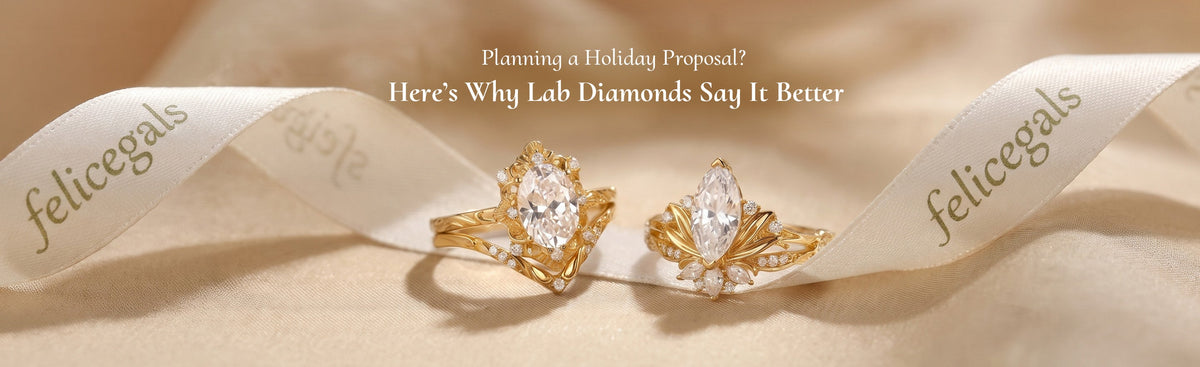
If you have started quietly researching a holiday proposal, you are not alone — and you are not early. Across the United States, December is the most popular month of the year to get engaged, with Christmas Eve and New Year's Eve competing for the most proposals in a single evening. Families gather, the calendar slows, and there is something almost cinematic about asking the most important question of your life while the room glows with candlelight and tree lights. For a christmas proposal, a lab diamond engagement ring may be the smartest decision you make — this guide explains why, from the honest budget math to the cuts that come alive under warm winter light.
At Felicegals, we have helped thousands of couples design the ring that marks the beginning of their forever. Every piece is handmade to order in solid 14K or 18K gold or 950 platinum, set with a genuine lab-grown diamond, and delivered with an IGI certificate. Whether you are imagining a classic lab grown diamond ring solitaire or a dramatic statement set, this guide walks you through the whole plan, start to finish.
Table of Contents
- Why the Holidays Are the Most Popular Time to Propose
- What "Lab Diamonds Say It Better" Actually Means
- More Sparkle for the Same Budget: The Honest Math
- Lab Diamond Cuts That Catch Candlelight & Tree Lights
- Timing, Shipping & Custom Orders: A Holiday Proposal Checklist
- Making the Ring Personal: Engraving, Metals & Sizing
- The Felicegals Lab Diamond Collection
Why the Holidays Are the Most Popular Time to Propose
December proposals are not a marketing invention — they are a genuine cultural rhythm that has repeated for generations. Jewelers have long observed a spike in engagement ring sales between Thanksgiving and Valentine's Day.
The first reason is proximity: the holidays are the one time of year when the people who matter most are already in the same room, so a proposal need not be staged as a separate event. The second is atmosphere — warm light, evergreen, snow, and a crackling fire do the staging for you. The third is symbolic renewal: the end of the year invites reflection and commitment. People propose in December because December already feels like a beginning.
For a winter engagement ring, that setting is not just flattering but thematically perfect — the ring will forever be tied to the season you chose to ask, which is why couples planning a holiday proposal want something that photographs beautifully against dark velvet and champagne. Once you decide on the holidays, everything downstream — the ring, the order, the shipping window — becomes a schedule you can follow. With a lab diamond, that timeline is friendlier than you might expect, because you are not competing with the waitlist for a rare mined stone.
What "Lab Diamonds Say It Better" Actually Means
The phrase sounds like a slogan, but it describes something concrete. A lab-grown diamond is, in every measurable way, a diamond: the same chemical composition (pure carbon), crystal lattice, hardness of 10 on the Mohs scale, and refractive index as a stone pulled from the earth. The only difference is origin — one formed underground over a billion years, the other grew in a laboratory in weeks by replicating those exact conditions.
So when we say a lab diamond "says it better," we mean it says the same thing — I love you, I am choosing you, this is forever — while keeping the resources that would have gone into a scarcity premium. That distinction matters for young couples in 2026, because a natural diamond's price is driven largely by rarity, not by any visible beauty advantage.
- Identical beauty. Same fire, same scintillation — a lab diamond is not an imitation or simulant. It is a real diamond.
- Identical durability. Just as hard and just as suitable for everyday wear as a mined stone.
- Documented and ethical. Every Felicegals lab diamond comes with an IGI certificate, with no mining footprint.
- Dramatically better value. The same budget buys a visibly larger, higher-clarity stone.
There is also an emotional case that resonates in winter. A lab diamond is a creation of human ingenuity — it exists because people chose to build it rather than dig for it. When you present a lab diamond engagement ring under tree lights, you are giving a stone whose beauty is real and whose story is entirely your own to tell.
More Sparkle for the Same Budget: The Honest Math
Lab diamonds typically cost 50–70% less than natural diamonds of comparable carat, color, and clarity. The same money that buys a modest natural solitaire can buy a substantially larger lab diamond with better color and clarity, or a full multi-piece bridal set with accent stones and an engraved band.
To make that concrete, consider a realistic holiday proposal budget of about $5,000 — right in the middle of what American couples spend. Compare what that single budget buys in each world.
| Same Budget ($5,000) | Lab Diamond | Natural Diamond |
|---|---|---|
| Typical Center Carat | 2.0 – 3.0 ct | 0.7 – 1.0 ct |
| Typical Clarity | VS – VVS (eye-clean) | SI1 – SI2 (inclusions visible) |
| Typical Color | D – F (colorless) | G – J (near-colorless) |
| Cut Quality | Excellent, precision-cut | Often compromised to preserve carat |
| Setting | Full bridal set with accent stones | Simple solitaire, limited budget |
| Documentation | IGI certificate on every stone | GIA or IGI, varies by seller |
| Price Feel | High value, low stress | Tight — forces compromises |
| Best Use | Maximum visible sparkle for a proposal | Collector value, resale speculation |
The difference is not cosmetic. A 2.5-carat lab diamond reads as a genuine statement on the hand, while a natural diamond of the same budget often means accepting visible inclusions just to reach one carat. At a holiday proposal, where the ring is revealed in a moment captured forever, that visible difference matters. Buying lab-grown is not a compromise; it is a deliberate choice to spend on things you can see. For how to set a target, see our guide on how much to spend on a lab diamond.
Lab Diamond Cuts That Catch Candlelight & Tree Lights
Winter proposal settings are visually unique. A holiday engagement happens in warm, directional, low light — candles, string lights, a fire, a chandelier — and that light rewards certain cuts far more than others. If your proposal will happen indoors at night, choose a cut that throws fire and broad flashes of sparkle rather than one that depends on crisp daylight.
- Round Brilliant — maximum fire; universally flattering; the safest sparkle choice.
- Oval — elongates the finger; looks larger per carat.
- Kite — bold, modern geometry; dramatic light streaks under tree lights.
- Marquise — regal and elongating; superb candlelight performance.
- Pear — soft and romantic; a teardrop that flatters every hand.
- Emerald / Asscher — step-cut sophistication; glowing, not glittering.
Ovals and rounds are the classic low-light choices: a well-cut round brilliant is engineered for maximum light return, and an oval adds a flattering elongated silhouette that makes the stone look larger than its carat weight. Kite, marquise, and pear cuts are the drama picks — elongated fancy shapes reflect light in long, brilliant streaks that read beautifully against a dark backdrop. Emerald and Asscher cuts produce broad, elegant flashes and a "hall of mirrors" depth that glows rather than twinkles.
Whichever cut you choose, cut quality matters more than any other single factor for sparkle — a well-proportioned lab diamond will outperform a larger, poorly cut one in every lighting condition. Explore our range of lab grown diamond rings to see these cuts side by side.
Timing, Shipping & Custom Orders: A Holiday Proposal Checklist
This is where many holiday proposals are won or lost. Because our rings are handmade to order, lead time is real, and December is the busiest month of the year for jewelers, shipping carriers, and engravers alike. The couple who plans backward from the proposal date avoids stress; the one who orders on December 15th pays for overnight shipping and prays.
Eight to twelve weeks out (early-to-mid October). This is the ideal window. Decide the cut and setting, choose the metal, and place your order with room to spare. Our made-to-order lab diamond pieces typically carry a 5–8 week lead time, so ordering in October means delivery well before December. This is also the time to sort out ring size.
Six weeks out (early November). Still comfortable for most designs, especially ready-to-ship silhouettes, with room for a resizing or a tweak. Four weeks out (late November) is the practical edge — it can still work if design and sizing are locked immediately. Two weeks out (early December) is genuinely tight, and you are gambling on production speed and peak-season carriers.
Two practical notes that save holiday orders every year. First, order the ring before finalizing the proposal plan — the ring is the long-lead item, and the venue and moment can be arranged in days. Second, if you are unsure of her ring size, do not guess; borrow a ring she already wears on the correct finger.
Making the Ring Personal: Engraving, Metals & Sizing
A proposal ring becomes irreplaceable the moment it carries a detail that is only yours. Personalization is one of the easiest ways to turn a beautiful ring into her ring, and it costs far less than people expect. At Felicegals, it is available across nearly every design.
Engraving. A short inscription inside the band — a date, initials, coordinates of a meaningful place, or a phrase only the two of you understand — is the most popular personal touch. It is hidden from the world, which makes it feel like a private promise, though it does add a little production time. Metals. Every Felicegals ring comes in solid 14K and 18K yellow, white, or rose gold, and in 950 platinum. Yellow gold is warm and classic; white gold is cool and modern; rose gold is romantic and softly vintage; platinum is the most durable and luxe-feeling. If you are unsure, look at the jewelry she already wears most often.
Sizing and sets. A ring that fits well is worn daily and happily; one that does not gets left in a drawer. We offer standard and custom sizes, and if the ring might need resizing, mention it at order time. A solitaire is pure and timeless; a bridal set adds a matching wedding band, giving the ring more presence and a head start on the wedding band itself. Every Felicegals lab diamond piece arrives with an IGI certificate.
The Felicegals Lab Diamond Collection
Every ring below features a genuine lab-grown diamond, set in solid 14K or 18K gold or 950 platinum, with IGI certification and handmade-to-order craftsmanship. We have organized ten of our most-loved designs into three groups — minimal solitaires, vintage and engraved pieces, and statement bridal sets — so you can find the ring that matches the proposal you are planning. Each is made especially for you, so please allow the noted lead time when you order for the holidays.
Solitaire & Minimal — clean, timeless, one stone that does all the talking.

Axel — Geometric Asscher Cut Lab Grown Diamond Ring

Kaelis — Oval Cut Lab Grown Diamond Engraved Solitaire

Audrey — Emerald Cut Lab Grown Diamond Baguette Vintage Ring
Statement Sets & Three-Stone — maximum presence for the proposal moment everyone will be photographing.

Twigs — Pear Cut Lab Grown Diamond Leafy Ring Set 2pcs

Willow — 1.0ct Kite Lab Grown Diamond Leafy Ring Set 2pcs

Tyler — Twin Flames Kite Cut Lab Grown Diamond Ring Set 3pcs

Ethan — Unique Oval Cut Lab Grown Diamond Halo Ring Set 3pcs
Frequently Asked Questions
1. Is a lab diamond a real diamond?
Yes. A lab-grown diamond is a genuine diamond with the same chemical composition (pure carbon), crystal structure, hardness (10 on the Mohs scale), and optical properties as a mined diamond. The only difference is that it grew in a laboratory instead of underground.
2. Why are lab diamonds better for a holiday proposal?
They deliver far more visible sparkle for the same budget, so your ring photographs beautifully in low, warm light. The shorter supply chain also makes ordering more predictable in December, and you can choose a larger, higher-clarity stone without sacrificing the wedding budget.
3. How much do lab diamonds cost compared with natural diamonds?
Lab diamonds typically cost 50–70% less than natural diamonds of comparable carat, color, and clarity. On a $5,000 budget you might choose a 2.0–3.0ct lab diamond with VS–VVS clarity and D–F color, where a natural stone of the same budget would typically be 0.7–1.0ct with visible inclusions.
4. When should I order a ring for a Christmas or New Year's proposal?
Ideally eight to twelve weeks ahead — early-to-mid October. Our made-to-order lab diamond pieces carry a 5–8 week lead time, and December is the busiest month for jewelers and carriers. Four weeks out is the practical edge; two weeks out is genuinely tight.
5. Which diamond cut sparkles best under candlelight and holiday lights?
Round brilliant and oval cuts offer the most immediate fire because they are engineered for maximum light return. Kite, marquise, and pear cuts produce dramatic elongated flashes that look spectacular against dark winter backdrops.
6. Can I engrave the ring or choose a specific metal?
Yes. Nearly every Felicegals design can be engraved with a date, initials, coordinates, or a private phrase, and every ring is available in solid 14K and 18K yellow, white, or rose gold, and in 950 platinum. Engraving adds a little production time.
7. Do lab diamonds come with a certificate, and what about returns?
Every Felicegals lab diamond piece comes with an IGI certificate documenting its quality. Because each piece is made specifically for you, we do not accept exchanges or returns on lab diamonds, but we do offer a warranty.
8. Where can I find lab diamond rings, and can I ask a question about my holiday proposal?
You can browse the full lab diamond rings collection at Felicegals, where every piece is handmade to order in solid gold or platinum with IGI certification. If you have a question about timing, cuts, sizing, or personalization before you order, email us at support@felicegals.com and our team will guide you personally.

